
 Available in US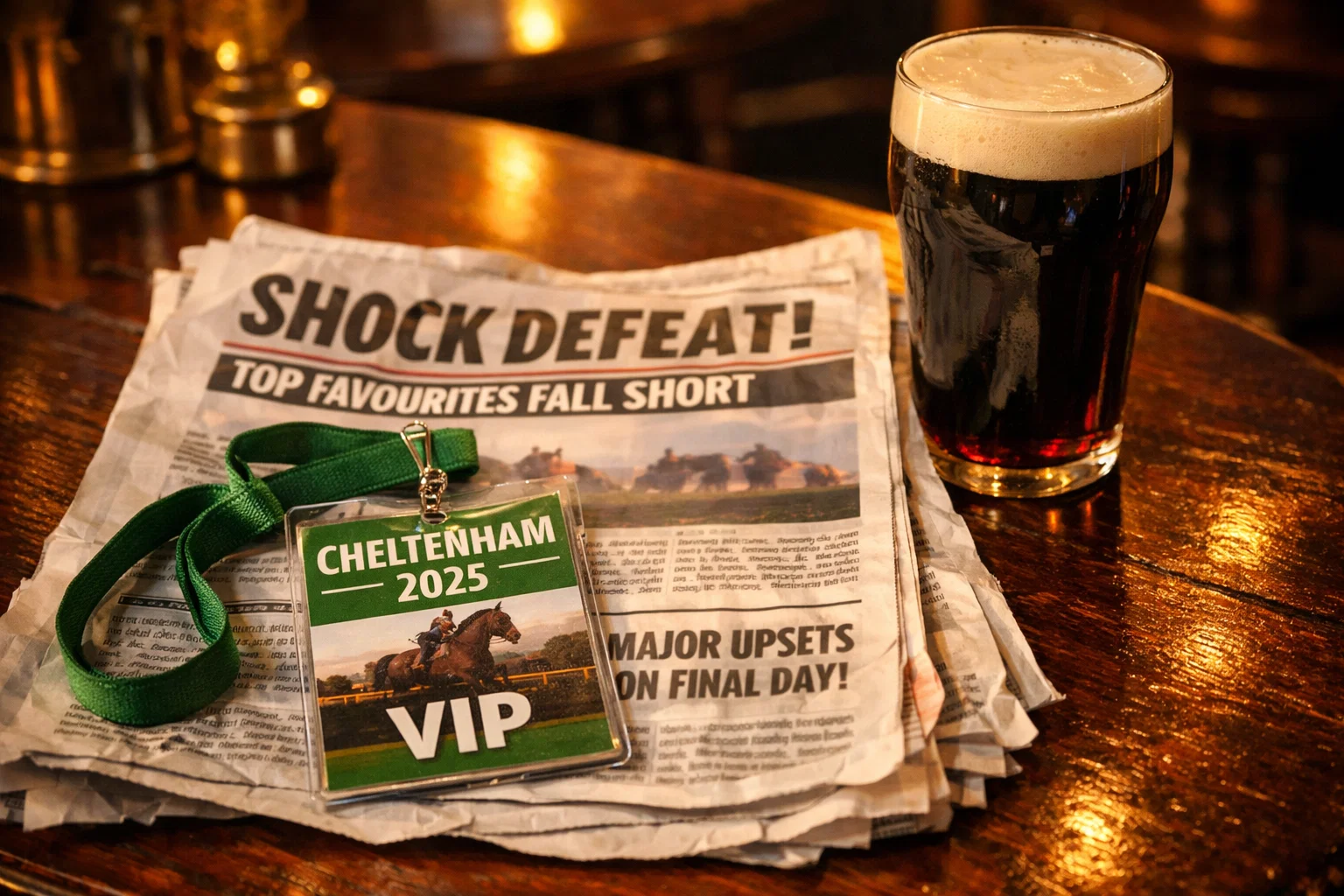
In this guide
When the Formbook Went Through the Shredder
The 2025 Cheltenham Festival was supposed to be predictable. Constitution Hill was odds-on for the Champion Hurdle. Majborough had been talked up as a certainty in the Supreme Novices. The ante-post markets had settled into comfortable patterns, and most punters were debating which short-priced favourites to include in their accumulator rather than questioning whether they would win at all.
Then Tuesday happened. And with it, a systematic dismantling of the conventional wisdom that would continue for the remaining three days. By Friday evening, all four championship race favourites had been beaten — a result so unusual that veteran bookmaker spokespeople struggled to recall a comparable Festival. Total attendance hit 218,839, a minimum for the past decade, yet the betting industry emerged from the week in something close to euphoria.
Understanding what happened in 2025 is not just a historical exercise. It is directly relevant to how you approach the offers, strategies, and selections for 2026. Last year’s shocks reshaped the ante-post markets, altered bookmaker promotional strategies, and provided a dataset that challenges some comfortable assumptions about Cheltenham betting.
See also: cheltenham betting offers — expert Cheltenham offers coverage.
Results Overview: The Four Championship Races
The Champion Hurdle set the tone on Tuesday. Constitution Hill, the defending champion sent off at cramped odds, never travelled with his usual fluency and finished well beaten. The market had priced him as near-certainty — and the market was comprehensively wrong. His defeat alone altered the economics of Day 1 for both punters and bookmakers.
The Supreme Novices, the Festival’s curtain raiser, provided the day’s other headline upset. Majborough, a heavily backed Irish raider, failed to justify favouritism in a race that had been billed as a formality. Between these two results, the opening hours of the Festival delivered a message that would echo through the remaining days: short prices were not to be trusted.
Wednesday’s Champion Chase and Thursday’s Stayers’ Hurdle completed the clean sweep. In both cases, well-supported favourites underperformed, replaced on the podium by horses trading at longer prices in the morning markets. The Gold Cup on Friday continued the theme, though by that point, few punters were still backing their pre-Festival accumulators with any confidence.
Across the full 28-race programme, the overall favourite strike rate fell below historical averages. It was not simply that one or two fancied horses had off days — the pattern was systemic, reflecting a competitive renewal that the ante-post markets had failed to price accurately.
The Upset Festival: Why 2025 Was Different
Paul Binfield, Paddy Power‘s press secretary, offered a blunt assessment after the final day. With nearly twenty years in the role, he described 2025 as the most punishing Festival for backers he could remember, pointing to the sheer volume of well-fancied horses that failed to perform. That is not commentary from a neutral observer — Binfield represents one of the biggest beneficiaries of favourite defeats — but it captures the scale of what happened.
Several factors contributed. The Irish challenge, which had dominated recent Festivals with an extraordinary strike rate, was less concentrated at the top of the market. Rather than a handful of overwhelming favourites backed by the full force of Closutton or Ballymore form, the 2025 renewal saw strength distributed more evenly across the fields. This made each race more competitive and harder to predict, exactly the kind of Festival where short prices carry disproportionate risk.
Ground conditions played a role too. Cheltenham’s drainage improvements over recent years have made the going more consistent, but the specific conditions in 2025 — testing in places, riding differently from the morning inspections — caught out horses whose form was established on different surfaces. Ground is the variable that no ante-post price can fully account for, and in 2025 it proved decisive in several championship races.
The broader lesson is simple: Cheltenham is not an event where the most expensive horse wins by default. The unique Prestbury Park terrain, the Irish-British rivalry, the emotional energy of the crowd, and the sheer quality of the fields make upsets structurally more likely here than at any other National Hunt meeting. Last year simply made that truth impossible to ignore.
Bookmaker Outcomes: Who Won Festival Week
The bookmakers, unequivocally. When your four championship favourites all lose, the liabilities that have been building in your risk models for months evaporate in real time. Lee Phelps of William Hill noted that the industry had been bracing for the worst heading into Day 1, with popular accumulators stacking serious potential payouts across the opening races. The defeats of Constitution Hill and Majborough on Tuesday alone spared the industry an estimated £50 million in payouts.
The financial impact extended beyond individual race results. The Gambling Commission’s market data showed that real-event betting gross gaming yield rose 5% in the quarter covering Cheltenham 2025, reaching £596 million. The Commission explicitly attributed part of that growth to results at the Festival that were favourable for operators. In practical terms, the 2025 Festival was one of the most profitable for the betting industry in recent memory.
That profitability filtered through to the Horserace Betting Levy Board, which posted a record annual yield — more bookmaker profit means a bigger levy pot, which means more money flowing back into racing prize funds and racecourse facilities. The irony is not lost on punters: the week they lost most fed the sport they love most generously.
For the individual bettor, the takeaway is more pragmatic than philosophical. When bookmakers have a good year, they have larger marketing budgets. Larger budgets translate to more aggressive offers the following year. Some of the generous promotions available for Cheltenham 2026 exist precisely because 2025 was so profitable for the industry.
Trends for 2026: What Last Year Signals
The 2025 Festival sent several signals that are directly relevant to how you approach Cheltenham 2026. The first and most obvious: the ante-post market can misjudge competitiveness. Lee Phelps of William Hill observed in late 2024 that the 2026 renewal was shaping up to be more evenly contested than recent years, with fewer standout favourites dominating the early markets. If that assessment holds, each-way betting and value-focused strategies will again outperform the approach of backing short-priced selections to win.
The attendance trend also matters. Festival attendance dropped to 218,839 in 2025, roughly 22% below the record 280,627 set in 2022. That decline has not been matched by a decline in betting volume — if anything, the concentration of wagering on Festival races has intensified, with all 28 races ranking among the top 31 most-bet-on races in Britain. The shift from on-course to online betting is accelerating, and bookmakers are responding with digital-first promotional strategies: app-exclusive offers, mobile-optimised sign-up processes, and in-play features that work better on a phone screen than a crowded betting ring.
From a strategic perspective, the 2025 results reinforce three principles for 2026. Use offers that provide downside protection — money-back specials, each-way extra places, NRNB on ante-post bets — because favourites losing is the norm, not the exception. Spread your stakes across the card rather than concentrating on championship races, where the emotional pull towards short-priced selections is strongest. And treat free bets as tools for accessing value at longer odds, not as free shots on horses you would not back with your own money.
Cheltenham 2025 was a reminder — delivered at the expense of millions in losing bets — that the Festival rewards preparation, discipline, and a healthy scepticism towards certainty. The horses that were supposed to win did not. The punters who survived best were those who planned for exactly that possibility.
Explore Cheltenham Festival history.
Learning From 2025 Without Chasing It
Reviewing past results should inform future strategy, not fuel a desire to recover losses. If the 2025 Festival left you out of pocket, resist the temptation to chase that deficit in 2026. Set a fresh budget, use deposit limits, and approach the new Festival as a standalone event. If you need support, contact GamCare (0808 8020 133) or visit www.begambleaware.org.
