
 Available in US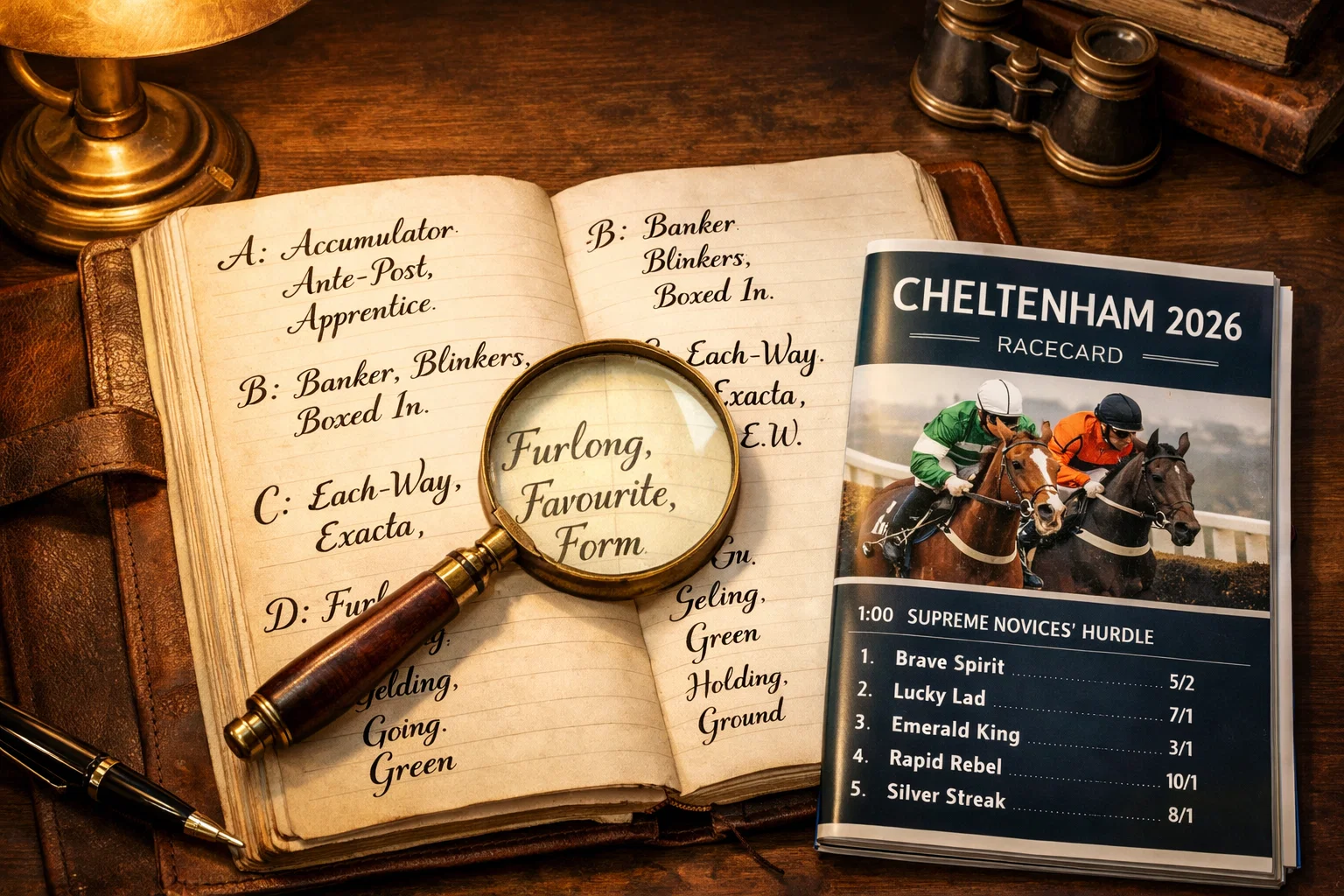
In this guide
Know the Language
Cheltenham Festival betting comes with its own vocabulary — a mix of racing terminology, bookmaker jargon, and offer-specific language that can leave newcomers feeling like they have walked into a conversation halfway through. Even experienced bettors occasionally encounter terms that are used loosely or inconsistently across different platforms.
This glossary covers the essential terms you will meet when navigating Cheltenham offers, reading racecards, and placing bets during the 2026 Festival. Each definition is kept short and practical: what the term means, why it matters, and where you are most likely to encounter it. The UK betting industry generates around £2.6 billion in remote betting gross gaming yield annually, with horse racing contributing £766.7 million of that figure — so the terminology below covers a significant slice of British sporting culture.
See also: cheltenham betting offers — your go-to Cheltenham betting site.
A–E: Accumulator to Extra Places
Accumulator (Acca) — A single bet combining four or more selections. All selections must win for the bet to pay out. Accumulators offer large potential returns from small stakes, which is why bookmakers promote them heavily during Festival week, often with acca insurance or profit boosts attached.
Ante-Post — A bet placed before the day of the race, often weeks or months in advance. Ante-post prices are typically more generous than day-of-race odds because you accept the risk that your selection might not run. Non Runner No Bet offers remove that risk on qualifying markets.
Best Odds Guaranteed (BOG) — A bookmaker policy where you receive whichever price is higher: the odds you took when placing your bet, or the starting price (SP) at the time the race begins. If you back a horse at 8/1 in the morning and it drifts to 10/1 by post time, you get paid at 10/1. Most major UK bookmakers offer BOG on horse racing, though some impose maximum payout limits.
Bet Builder — A feature allowing you to combine multiple selections within a single race into one bet. Common in football, it is increasingly available for horse racing at Cheltenham, where you might combine a winner selection with a finishing margin or jockey-specific market.
Bet Credits — The form in which many free bets are issued. Bet credits sit in your account and can be used to place wagers, but the stake itself is not returned with any winnings (see Stake Not Returned). They usually carry an expiry date — often seven days from issue — so timing their use during Festival week matters.
Cash Out — A feature that lets you settle a bet before the event finishes, locking in a profit or cutting a loss. Bookmakers calculate a cash-out value based on the current state of play. Partial cash out allows you to settle part of the bet and leave the rest running. Availability varies by market and bookmaker.
Each Way — A bet that is effectively two bets in one: one on your selection to win and one on it to finish in the places (typically top two, three, or four depending on field size). The place part pays a fraction of the win odds — usually 1/4 or 1/5. Each-way betting is particularly popular in large-field Cheltenham handicaps where picking the winner outright is difficult.
Enhanced Odds — A promotional price offered above the standard market odds, usually on high-profile races. Enhanced odds on a Cheltenham favourite might boost 4/1 to 6/1, but these offers almost always carry maximum stake limits (sometimes as low as £1) and may pay winnings as free bets rather than cash.
Extra Places — A promotion where the bookmaker pays out on more finishing positions than standard place terms allow. In a standard 16-runner handicap you might get three places; an extra places offer extends that to four or five. This increases the chance of your each-way bet returning something, particularly in competitive Festival handicaps.
F–N: Form Guide to Non Runner No Bet
Form Guide — A record of a horse’s recent racing results, typically presented as a string of numbers and letters. A form figure of “1121” means the horse won its last race, finished second before that, won the two prior to that. Letters indicate other outcomes: F for fell, P for pulled up, U for unseated rider. Form is the starting point for any serious Cheltenham analysis.
Going — The condition of the ground on race day. Described on a scale from Firm (fast, dry ground) through Good, Good to Soft, Soft, and Heavy (waterlogged). Going affects which horses perform well — some relish soft ground, others need it firm. At Cheltenham in March, Soft or Good to Soft is the most common going, though weather can change conditions significantly between Tuesday and Friday.
Handicap — A race where horses carry different weights based on their official rating, designed to equalise their chances. Cheltenham features several high-profile handicaps, including the County Hurdle and the Ultima Handicap Chase. These large-field races are where each-way betting and extra-places offers tend to deliver the most value.
Hurdle — A jump racing obstacle made of flexible material. Hurdle races at Cheltenham are run over smaller obstacles than steeplechases and tend to feature faster racing. The Champion Hurdle on Day 1 and the Stayers’ Hurdle on Day 3 are the Festival’s premier hurdle events.
In-Play Betting — Placing bets after a race has started. In-play markets on horse racing are fast-moving, with odds shifting dramatically as the field rounds each fence or hurdle. Not all bookmakers offer in-play on every Cheltenham race, and the feature requires a reliable mobile connection if you are betting from the course.
Lay Bet — A bet against a selection winning, placed on a betting exchange (such as Betfair or Smarkets). Laying is the foundation of matched betting, where you back a selection with a bookmaker’s free bet and lay the same selection on an exchange to guarantee a profit regardless of the outcome.
Lucky 15 — A bet consisting of 15 separate wagers across four selections: four singles, six doubles, four trebles, and one four-fold accumulator. Popular during Cheltenham because you can pick one horse per day. Many bookmakers offer consolation bonuses on Lucky 15s — for instance, paying treble odds if only one selection wins.
Matched Betting — A technique for converting free bet offers into guaranteed profit by placing opposing bets (back and lay) across a bookmaker and an exchange. It is not gambling in the traditional sense — the outcome is financially neutral, with profit coming from the free bet’s value. Conversion rates typically land between 70% and 80% of the free bet’s face value.
Money-Back Offer — A promotion where your stake is refunded if certain conditions are met — for instance, if your horse finishes second or third, or if a specific favourite wins. The refund may come as cash (more valuable) or as a free bet (less valuable, due to stake-not-returned rules). Always check which format applies.
National Hunt — The branch of horse racing that involves jumping obstacles, as opposed to flat racing. Cheltenham Festival is the pinnacle of National Hunt racing in Britain and Ireland. All 28 Festival races are run under National Hunt rules, over either hurdles or fences.
Non Runner No Bet (NRNB) — A bookmaker policy that refunds your stake if your selected horse does not run. Standard ante-post bets carry the risk of losing your money if a horse is withdrawn before race day. NRNB removes that risk, making it a valuable feature for early-bird Cheltenham wagers where prices are better but withdrawal risk is higher.
O–Z: Odds to Wagering Requirement
Odds — The price offered on a selection, representing the bookmaker’s assessment of probability and the payout if you win. UK odds are traditionally displayed as fractions (5/1) but increasingly shown in decimal format (6.0). Decimal odds include your returned stake: a £10 bet at 6.0 returns £60 total (£50 profit plus your £10 stake).
Overround — The built-in margin a bookmaker applies to a market. If you convert all the odds in a race to implied probabilities and add them up, the total will exceed 100% — the excess is the overround, and it represents the bookmaker’s theoretical profit margin. Lower overrounds mean better value for the bettor. Cheltenham feature races tend to have tighter overrounds than midweek handicaps at smaller courses.
Place Terms — The rules governing the place portion of an each-way bet: how many places are paid and at what fraction of the win odds. Standard terms vary by field size: races with five to seven runners typically pay two places at 1/4 odds; eight to fifteen runners pay three places at 1/5 odds; sixteen or more runners pay four places at 1/4 odds. Bookmakers may offer enhanced terms during the Festival.
Price Boost — An enhanced price offered on a specific selection or market, usually available for a limited time. Price boosts are less dramatic than super boosts and typically carry higher maximum stakes. They are refreshed daily during Cheltenham, often appearing in a dedicated section of the bookmaker’s app.
Qualifying Bet — The initial bet you must place to trigger a free bet offer. Qualifying bets usually require a minimum stake (commonly £10), minimum odds (often evens or 1/2), and must be placed as a specific bet type (frequently singles only). Getting the qualifying bet wrong is the most common reason punters miss out on their free bet.
Rollover (Wagering Requirement) — The number of times you must wager the value of a bonus before withdrawing profits. A 3x rollover on a £10 free bet means you need to place £30 in qualifying bets before any winnings can be withdrawn. Many Cheltenham offers from major bookmakers carry no rollover on free bet profits, but always check the terms.
Starting Price (SP) — The official odds on a horse at the moment the race starts, determined by on-course bookmaker prices. SP matters because Best Odds Guaranteed compares your taken price against SP and pays the higher of the two. If you did not take an early price, SP is what you receive.
Stake Not Returned (SNR) — The standard condition on most free bets: when you win, you receive your profit but not the free bet stake itself. A £30 free bet at 4/1 returns £120 profit, not £150. This is why the real value of a free bet is lower than its face value — typically around 60–75% of the nominal amount.
Steeplechase — A jump race over larger, fixed obstacles (fences), as distinct from hurdle races. The Gold Cup is the Festival’s premier steeplechase, run over three miles and two and a half furlongs on Friday afternoon.
Super Boost — An extreme enhanced-odds offer, often inflating prices to headline-grabbing levels (60/1 on a short-priced favourite, for instance). Super boosts virtually always carry maximum stakes of £1 or £2 and may pay winnings in free bets rather than cash. They are primarily marketing tools — eye-catching but limited in actual value.
Tote — A pool betting system where all stakes on a race are pooled together and dividends are calculated after deductions. Tote bets are available on-course and online. Tote dividends can sometimes exceed bookmaker fixed-odds payouts, particularly in less popular races where the pool reflects fewer informed opinions.
Turnover — The total amount wagered. Industry turnover figures, such as William Hill’s projected £450 million for the 2026 Festival, represent total stakes placed rather than profit. Not to be confused with GGY (Gross Gaming Yield), which is turnover minus payouts to customers.
Wagering Requirement — See Rollover. The terms are used interchangeably. When evaluating a Cheltenham offer, check whether any wagering requirement applies to profits from your free bet before they can be withdrawn. Some operators use the phrase “playthrough” to mean the same thing.
Discover the types of Cheltenham betting offers.
From Knowledge to Self-Awareness
Understanding the terminology is the first step towards informed betting. The second is knowing your limits. Set deposit limits before the Festival, use the tools described in every bookmaker’s responsible gambling section, and never bet more than you can afford to lose. If gambling becomes a problem, contact GamCare (0808 8020 133) or visit www.begambleaware.org for free, confidential support.
