
 Available in US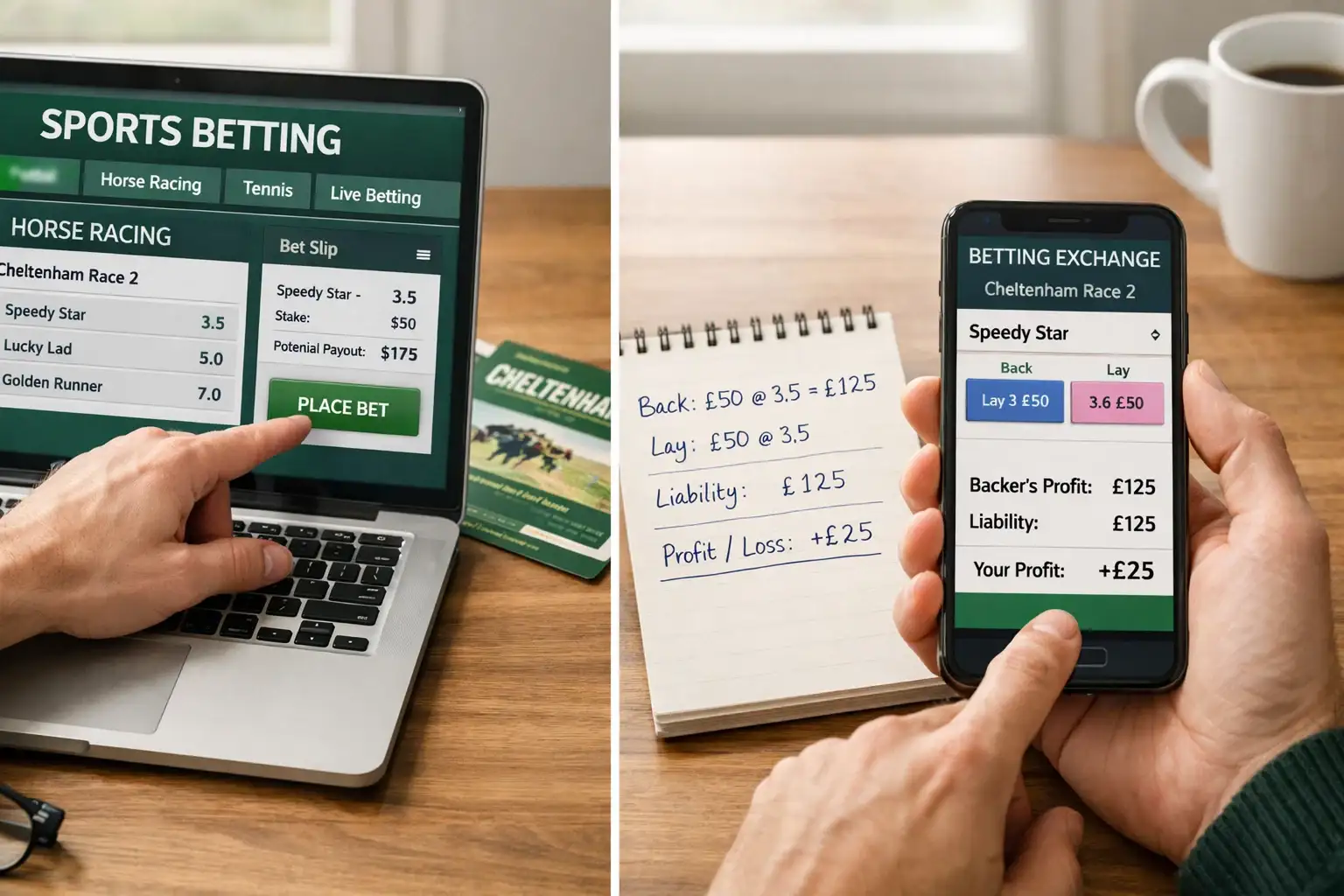
In this guide
A Mathematical Process, Not a Gamble
Matched betting is not gambling. That distinction matters. Where traditional betting relies on picking winners — a task that even professional punters get wrong more often than right — matched betting uses bookmaker promotions as raw material for a mathematical process that extracts guaranteed profit regardless of the race result.
The principle is straightforward: you place a bet with a bookmaker using a free bet or promotional offer, then place an opposing bet on a betting exchange to cover all outcomes. One side wins, the other loses, and the net result is a locked-in profit derived from the free bet’s value. At the 2025 Cheltenham Festival, all four championship race favourites were beaten — as William Hill’s Lee Phelps noted, getting all four short-priced favourites beaten in the championship races was beyond what bookmakers had dared hope for. For matched bettors, those results were irrelevant. The profit was locked in before the first horse left the stalls.
Cheltenham Festival is the single best week of the year for matched betting in UK racing. The volume of promotional free bets available — from sign-up offers to daily boosts to acca insurance refunds — creates a dense pipeline of convertible offers across four days. According to OddsIndex, typical matched betting conversion rates sit at 70–80% of a free bet’s face value, meaning a £30 free bet can be converted into approximately £21–£24 in withdrawable cash. Across multiple bookmakers and multiple days, those conversions accumulate into meaningful returns. Guaranteed extraction is the goal, and the Festival provides the opportunity.
See also: cheltenham betting offers — everything about Cheltenham betting deals.
Matched Betting Basics: Back and Lay Explained
The core mechanism of matched betting requires two accounts: one with a bookmaker (where you “back” a selection to win) and one with a betting exchange (where you “lay” the same selection, effectively betting against it). The exchange is not a bookmaker — it is a marketplace where punters bet against each other. Betfair Exchange and Smarkets are the two primary exchanges used in the UK.
A matched bet works in two phases. The first phase is the qualifying bet, placed with your own money at the bookmaker to activate the free bet offer. You back a horse at the bookmaker and lay the same horse at the exchange. If the horse wins, the bookmaker pays out but the exchange bet loses. If the horse loses, the exchange pays out but the bookmaker bet loses. The two outcomes roughly cancel out, leaving you with a small net loss called the qualifying loss — typically £0.50 to £2 on a £10 bet, depending on the odds and commission rates. This qualifying loss is the cost of unlocking the free bet.
The second phase is the free bet conversion. You now have a free bet from the bookmaker. You back a horse using the free bet and lay the same horse on the exchange. Because the free bet is stake-not-returned, the calculation differs from the qualifying bet. If the horse wins, the bookmaker pays the winnings (but not the stake), and the exchange bet loses. If the horse loses, the exchange pays out. The asymmetry of the SNR free bet means the net result is always positive — you extract a portion of the free bet’s value as guaranteed cash profit.
The maths is consistent and repeatable. For a £10 free bet used on a selection at 5.0 (4/1 decimal), the bookmaker pays £40 profit if it wins (stake not returned). The lay bet at the exchange covers the losing scenario. After accounting for exchange commission (typically 2–5%), the net profit from converting a £10 free bet is approximately £7–£8. The exact figure depends on the odds chosen, the exchange commission rate, and the size of any qualifying loss from the first phase.
No specialist knowledge of horse racing is required. The selection itself does not matter — you are not betting on the horse’s chance of winning. You are using the horse as a vehicle to balance two opposing bets. The profit comes from the bookmaker’s promotional subsidy, not from predicting race outcomes.
Lay Strategy for Cheltenham Offers
Not all odds ranges are equally efficient for matched betting. The lay strategy — choosing the right price at which to back and lay — determines how much profit you extract from each free bet and how much risk you carry during the process.
For qualifying bets (where the goal is to minimise the qualifying loss), lower odds are better. Backing and laying a horse at 2.0 (evens) produces a smaller gap between the back and lay prices, resulting in a qualifying loss of around £0.30–£0.50 on a £10 bet. At higher odds — say, 6.0 or 8.0 — the gap widens and the qualifying loss increases. Unless the bookmaker’s minimum odds requirement forces you to use a higher price, always qualify on selections as close to evens as the terms allow.
For free bet conversion (where the goal is to maximise profit), the optimal odds range is typically 4.0 to 8.0 (3/1 to 7/1 in fractional). At these odds, the profit extracted per free bet is highest relative to the exchange liability. At very low odds (2.0), the profit per free bet drops because the potential winnings are small. At very high odds (20.0+), the exchange liability becomes large relative to the profit, and the risk of a pricing error increases. The sweet spot for Cheltenham free bet conversion sits around 5.0 to 6.0.
Cheltenham-specific considerations affect the lay strategy. Festival races attract enormous exchange liquidity — more money is traded on Betfair during Cheltenham week than any other racing fixture — which means lay bets are matched quickly and at tight spreads. This is a significant advantage for matched bettors, because wide spreads between back and lay prices eat into profit margins. The deep liquidity at Cheltenham means you can convert free bets efficiently even on less fancied runners.
Large field sizes in handicaps also help. A 20-runner race offers more selections at suitable odds than a 5-runner championship event. You have more flexibility to find a horse trading at 5.0 with a tight lay spread in the County Hurdle than in the Champion Chase. Plan your conversions around the bigger fields where possible.
Expected Returns from Festival Offers
The numbers are concrete enough to plan around. According to OddsIndex, a free bet with a face value of £10 has a real value of approximately £6–£7.50 when used as a standard bet. Through matched betting, the conversion rate rises to 70–80% of face value, yielding £7–£8 per £10 free bet. The improvement comes from the structured hedging that removes the variance — you are guaranteed the profit rather than relying on the free bet to win.
Apply this to a typical Cheltenham sign-up offer. A “Bet £10 Get £30 in Free Bets” deal involves a qualifying bet of £10 (producing a qualifying loss of roughly £0.50–£1.50) followed by three £10 free bet conversions at £7–£8 each. The total profit is approximately £21–£24 minus the qualifying loss, netting around £20–£23. From a £10 initial outlay, that is a return of over 200%.
Across the Festival, a disciplined matched bettor working through sign-up offers from four or five bookmakers could generate £80–£120 in guaranteed profit from welcome offers alone. Add daily free bet promotions for existing customers — which are typically smaller (£5–£10) but available across all four days — and the total extraction from Festival promotions can reach £150–£200. These are realistic figures based on actual offer values, not theoretical maximums.
The time investment is modest. Each matched bet sequence (qualifying bet plus free bet conversion) takes approximately 10–15 minutes to execute, including checking odds, placing the back bet, and placing the lay bet. For a £20–£23 profit per sign-up offer, the effective hourly rate of matched betting during Cheltenham week is comfortably in double figures.
Exchange Comparison: Betfair vs Smarkets for Cheltenham
The exchange you use affects your profit on every conversion. The two relevant platforms for UK matched bettors are Betfair Exchange and Smarkets, and the choice between them comes down to two factors: commission rates and liquidity.
Betfair charges a standard commission of 5% on net winnings per market (reduced for high-volume users through loyalty tiers). Smarkets charges 2%, making it the cheaper option on a per-bet basis. On a lay bet that pays out £40, the Betfair commission is £2.00 and the Smarkets commission is £0.80. Over the course of the Festival, this difference adds up — particularly if you are converting multiple free bets per day.
Liquidity, however, favours Betfair. As the larger and older exchange, Betfair attracts more volume on Cheltenham races, which means lay bets are matched faster and the gap between back and lay prices is tighter. On the biggest races — the championship events and the major handicaps — both exchanges offer sufficient liquidity. On smaller races earlier in the card, Betfair may have significantly more available money than Smarkets, making it easier to get your lay bets matched at favourable prices.
The practical recommendation for Cheltenham 2026 is to have accounts with both exchanges. Use Smarkets for conversions on the high-liquidity feature races where the tighter commission directly improves your profit margin. Use Betfair for conversions on less liquid races where the priority is getting your lay bet matched quickly at a tight spread. Checking both exchanges before placing each lay bet takes 30 seconds and can add £1–£2 per conversion to your profit.
Use our free bet calculator for Cheltenham.
Discipline Within the Matched Betting Process
Matched betting is a mathematical process, not traditional gambling, but it still involves placing bets and managing money. Stick to promotional offers only and never use your own funds for speculative bets alongside the matched betting process. Keep records of every qualifying bet, free bet conversion, and net profit to maintain control of your bankroll.
If you find the process stressful or if it leads you into additional gambling beyond the matched bets, stop. Support is available from BeGambleAware.org and the National Gambling Helpline on 0808 8020 133.
