
 Available in US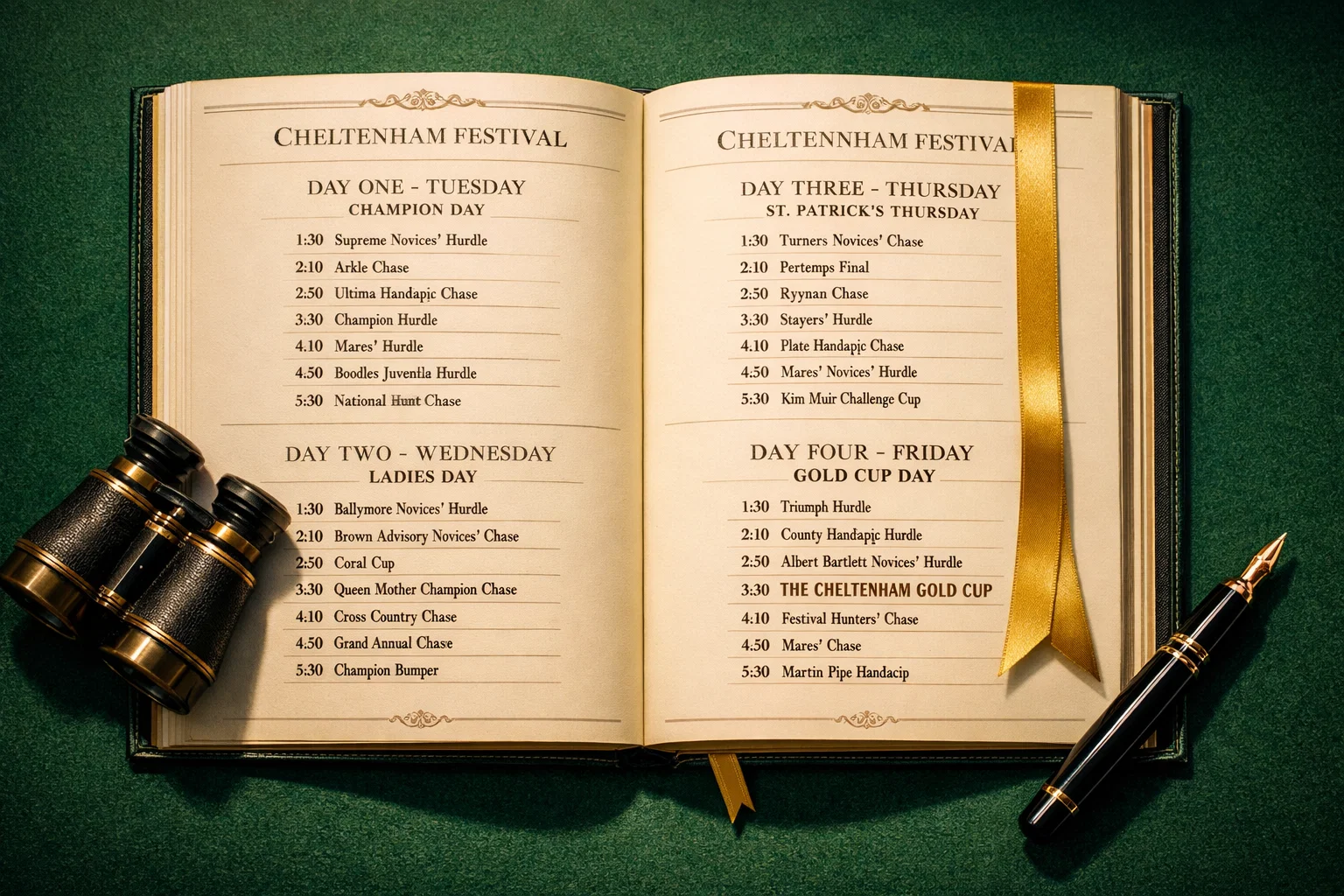
In this guide
The Framework for Every Festival Decision
Four days, 28 races, and a promotional landscape that shifts with every result. Before you can plan which offers to use, which bets to place, and how to allocate your Festival budget, you need to know when each race runs and what type of contest it is. The schedule is the skeleton on which every other decision hangs.
Cheltenham Festival 2026 runs from Tuesday to Friday in March, with seven races per day between approximately 1:30pm and 5:30pm. Each day is anchored by a championship-level feature race — Champion Hurdle on Tuesday, Champion Chase on Wednesday, Stayers’ Hurdle on Thursday, and Gold Cup on Friday — with six supporting races filling the card around it. All 28 races rank inside the top 31 most-wagered events of the year, a concentration of betting volume unmatched by any other fixture in British racing.
The schedule’s structure has direct implications for your betting approach. Race times determine when qualifying bets settle and free bets credit. Field sizes — which vary dramatically between Grade 1 championship events and handicap heats — shape which promotional offers apply. And the sequencing of races across the afternoon affects how you deploy free bets, when you cash out, and where your attention needs to be sharpest. As Ian Renton of The Jockey Club observed after the record 2022 attendance, the Festival’s schedule is carefully designed to maximise both the racing spectacle and the broader experience. For bettors, that design also creates a framework for maximising value. Your four-day planner starts here.
See also: cheltenham betting offers — all Cheltenham offers compared.
Day-by-Day Schedule: Tuesday to Friday
Tuesday — Champion Hurdle Day. The Festival opens with the Supreme Novices’ Hurdle at approximately 1:30, a Grade 1 for novice hurdlers over two miles that traditionally produces the first major result of the week. The Arkle Challenge Trophy (Grade 1 novice chase, 2m) follows, then the Mares’ Hurdle, the Champion Hurdle at 3:30 (the day’s centrepiece), the Boodles Juvenile Handicap Hurdle (one of Tuesday’s best each-way races with 16+ runners), the National Hunt Chase, and a closing bumper. Tuesday’s card is the most diverse of the week, mixing small-field Grade 1 races with a large-field handicap.
Wednesday — Champion Chase Day. Also known as Ladies Day, Wednesday’s card features the Ballymore Novices’ Hurdle (Grade 1, 2m5f), the Brown Advisory Novices’ Chase (Grade 1, 3m), the Coral Cup (handicap hurdle, 2m5f — typically 20+ runners and a prime each-way race), the Champion Chase at 3:30 (the two-mile championship), the Cross Country Chase (unique course configuration), the Mares’ Chase, and a closing handicap. Wednesday’s Coral Cup is the standout each-way opportunity of the day, often attracting the Festival’s largest field.
Thursday — Stayers’ Hurdle Day. Thursday’s card includes the Turners Novices’ Chase (Grade 1, 2m4f), the Pertemps Network Final (handicap hurdle, 3m — large field, strong each-way territory), the Ryanair Chase (Grade 1, 2m5f — effectively a third championship chase), the Stayers’ Hurdle at 3:30 (the three-mile championship), the Mares’ Novices’ Hurdle, the Plate Handicap Chase, and a closing race. Thursday features three high-quality feature races (Ryanair, Stayers’, Pertemps), making it arguably the strongest card for competitive betting.
Friday — Gold Cup Day. The Festival finale opens with the Triumph Hurdle (Grade 1 juvenile hurdle, 2m1f), followed by the County Hurdle (handicap, 2m1f — maximum-field race and the week’s premier each-way betting heat), the Albert Bartlett Novices’ Hurdle (Grade 1, 3m), the Gold Cup at 3:30 (the defining race of the Festival), the Foxhunter Chase (amateur riders), the Grand Annual (handicap chase, 2m), and a closing Martin Pipe Conditional Jockeys’ Handicap Hurdle. Friday’s County Hurdle and Grand Annual both attract maximum fields and extra-place offers.
Across all four days, the approximate gap between races is 35 minutes. This is the window in which settled bets produce credited free bets, cash-out opportunities arise, and the next race’s market takes final shape. The 35-minute rhythm is the operational heartbeat of Festival betting.
Feature Races: The Four Championships and Their Supporting Cards
The four championship races — Champion Hurdle, Champion Chase, Stayers’ Hurdle, and Gold Cup — share the 3:30 time slot on their respective days. This consistency helps punters plan their afternoon around the feature, knowing that the most heavily promoted race of each day arrives at the same time. It also means the morning’s price movements on the championship race have the same four-to-five-hour window to develop, regardless of the day.
Each championship attracts the deepest promotional coverage: enhanced odds on the favourite, money-back-if-second, race-specific free bets, and BOG on early prices. The supporting card surrounding each championship varies in promotional intensity. Races immediately before and after the feature tend to receive lighter promotional attention because bookmakers focus their resources on the main event. This creates a pattern worth exploiting: the best value in terms of offers may sit on the earlier races (where competition for your bet is lower and bookmakers offer broader terms) rather than on the championship race itself (where conditions are tighter due to higher liability).
The big handicaps — Boodles Juvenile, Coral Cup, Pertemps Final, County Hurdle, Grand Annual, Martin Pipe — are the supporting races that attract the strongest each-way and extra-place offers. Their large fields (16 to 24+ runners) mean standard place terms are already generous, and extra-place promotions push them further. These races are where each-way punters should concentrate their attention, particularly if their Cheltenham strategy is built around place returns rather than outright winners.
The BHA’s ongoing work to reduce race clashes — clashing has fallen from 11.1% in 2022 to 5.8% in 2024 — ensures that Cheltenham’s television and streaming coverage is uninterrupted, meaning every race is available live on your app without overlap. For punters relying on live streaming to inform in-play decisions, this clash reduction is a practical benefit.
How the Schedule Affects Your Betting Plan
The schedule creates timing constraints that directly affect how you deploy offers and manage your bankroll. Three patterns are worth building into your Festival plan.
First, qualifying bet timing. If you are using a sign-up offer that requires a qualifying bet before crediting free bets, place the qualifier on the first race of the day (approximately 1:30). The earlier the qualifying bet settles, the sooner your free bets credit, and the more races remain for you to use them on. A qualifying bet on the 5:30 closing race credits free bets after racing has finished, leaving you to use them the next day or on non-Festival events.
Second, free bet expiry windows. Most free bets expire 7 days after credit. If your free bets are credited on Tuesday (Day 1), they typically expire the following Tuesday — giving you the full Festival plus a few extra days. If credited on Friday (Day 4), they expire the following Friday, after the Festival has ended. This means free bets received later in the week must be used more urgently and may need to be deployed on Festival races rather than saved for calmer midweek racing. Plan your sign-ups and qualifying bets to maximise the usable window.
Third, the afternoon energy curve. The first two races on each day’s card (1:30 and 2:10 approximately) run before the championship race, and three races follow it (approximately 4:10 to 5:30). The post-championship races often receive less attention from the broader audience, which can create better each-way value as the market is thinner and less efficient. If you have unused free bets or daily promotions after the feature race, the later afternoon races deserve a look rather than being written off as the end of the day.
Check Day 1 betting offers at Cheltenham.
Building Breaks Into Your Schedule
The density of the Festival schedule — seven races in four hours, four days running — can create a compulsive rhythm. You do not need to bet on every race. Identify your target races in advance, use the schedule to plan your breaks, and step away from the screen between races if you feel the pace becoming overwhelming.
Support is available from BeGambleAware.org and the National Gambling Helpline on 0808 8020 133.
