
 Available in US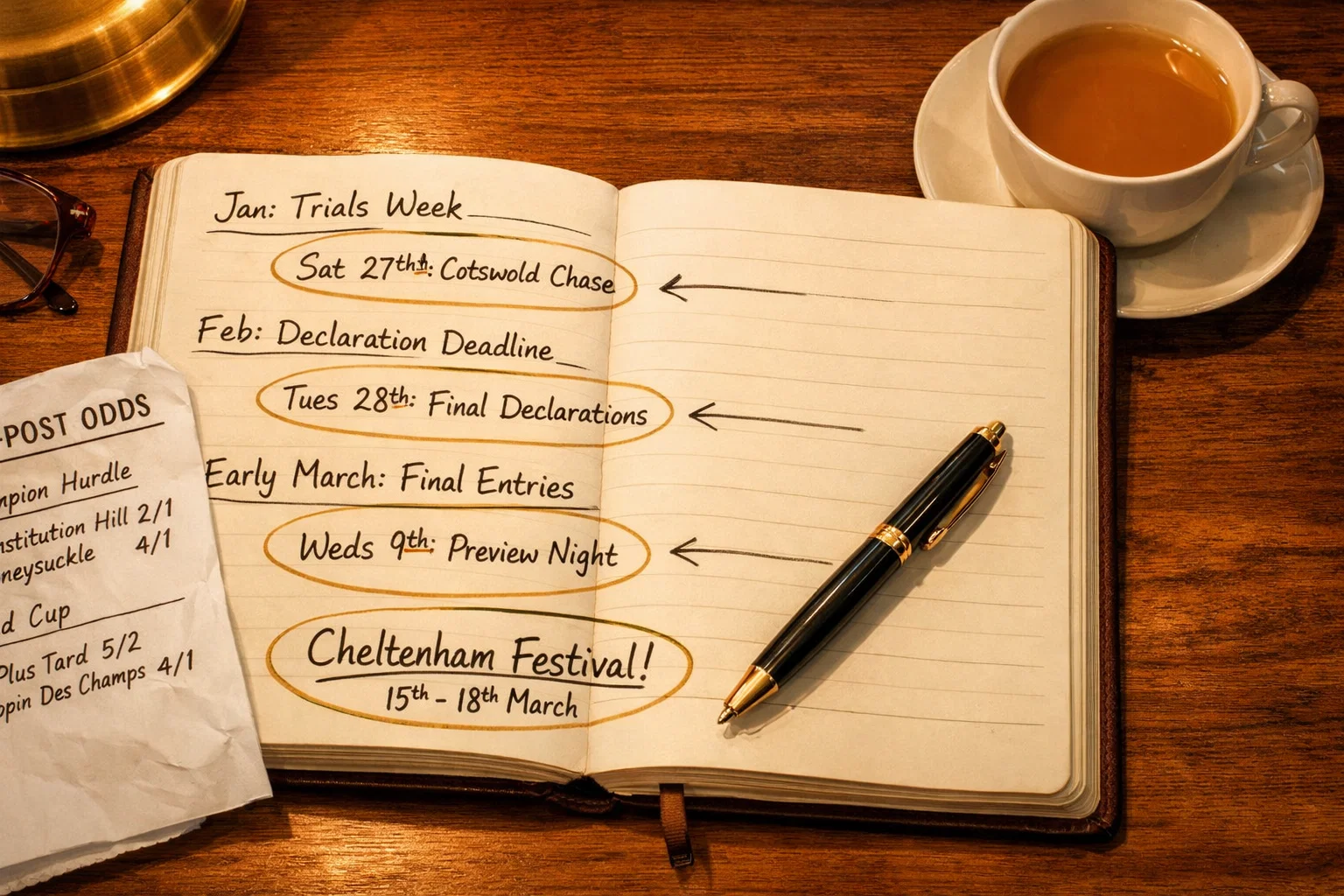
In this guide
Where the Sharpest Prices Hide
The best prices at Cheltenham Festival are not available during Festival week. They are available weeks, sometimes months, before the first horse enters the parade ring. Ante-post betting — placing bets on races that have not yet been declared — is where the sharpest value consistently sits, because the market is less efficient, the bookmaker’s overround is wider, and the crowd of money that compresses prices closer to race day has not yet arrived.
The trade-off is risk. An ante-post bet on a horse that does not run is a lost stake. Injuries, illness, going concerns, and trainer decisions all conspire to withdraw horses between the time you bet and the time the race takes place. But the evolution of NRNB (Non Runner No Bet) offers has fundamentally altered this equation. With NRNB protection, you keep the early price advantage without carrying the non-runner downside. The price is right — weeks early.
The ante-post market for Cheltenham 2026 has been active since the previous Festival ended. The winter jumps season, with its trials at Leopardstown, Ascot, Kempton, and Cheltenham itself, has progressively narrowed the markets. But significant value remains for punters who understand the timing patterns, know which bookmaker promotions complement ante-post positions, and can read the market signals that precede major price movements.
See also: cheltenham betting offers — your Cheltenham offers information hub.
Ante-Post Timing: When to Strike
Ante-post prices for Cheltenham follow a predictable cycle, and understanding this cycle is the foundation of pre-Festival betting strategy.
The earliest prices appear in the weeks after the previous year’s Festival, typically April and May. These are wide, speculative markets with generous odds that reflect extreme uncertainty. Very few punters bet this early, and the bookmakers’ margins are at their widest. The value can be exceptional, but so can the risk: you are betting on horses that may not even be in training by the following March.
The first significant narrowing happens in autumn, between October and December. The jump season is underway, early-season form is emerging, and the likely Cheltenham targets are becoming clearer. This is when the market begins to take shape, and the biggest ante-post price movements occur. A horse that wins impressively at a Grade 1 in November might shorten from 16/1 to 6/1 overnight. Punters who identified that horse at the longer price have captured substantial value.
The second compression happens in January and February, when the key trials are run. The Christmas meetings (Leopardstown, Kempton) and the February fixtures (the Betfair Hurdle at Newbury, the Game Spirit Chase) provide the final form lines before the Festival. Prices at this stage are tighter but still significantly longer than they will be on race day. A horse at 8/1 in February might be 5/1 by Tuesday morning. The February window is the last realistic opportunity for meaningful ante-post value before the market matures.
The final stage is the five-day declaration period, when trainers confirm their runners. At this point, most withdrawals happen, NRNB protection activates (if applicable), and the market moves into its final pre-race configuration. Prices between declaration and race day are technically ante-post but carry much lower withdrawal risk, making them the lowest-risk, lowest-reward option in the ante-post timeline.
The optimal strategy is to take positions in the October–December window for horses you have strong confidence in, using NRNB where available. Add to positions or take new ones in the January–February window as trial form confirms or adjusts your views. And use the declaration-stage market for final, lower-risk additions. This tiered approach captures value at multiple points without overcommitting at any single stage.
NRNB and Ante-Post: De-Risking Early Bets
The relationship between NRNB and ante-post betting is symbiotic. Ante-post prices are better because they carry non-runner risk. NRNB removes that risk while (at most operators) preserving the price advantage. The combination is one of the most favourable structures available to racing punters.
Not all bookmakers offer NRNB from the same point. Some apply it to all ante-post markets from the moment they open. Others activate NRNB only from a specific date — commonly four weeks before the Festival, or from the five-day declaration stage. The timing of NRNB activation determines whether your early bet is protected. A bet placed in November without NRNB carries full withdrawal risk until the race. A bet placed in February with NRNB carries none.
For 2026, attendance trends reinforce the value of online ante-post betting with NRNB. Festival attendance fell to 218,839 in 2025 — the lowest in a decade — while online ante-post markets have grown. The shift from on-course to online betting means more punters are engaging with the Festival through their screens rather than at the track, and NRNB is the feature that makes early online engagement risk-free.
As William Hill’s Lee Phelps noted when assessing the 2026 ante-post market, there are fewer obvious favourites this year and the races are shaping up to be more competitive than in recent seasons. This competitive depth increases both the potential value of early prices (more horses at longer odds) and the potential for late withdrawals (more tactical switching by trainers). NRNB protection is particularly important in a year like this, where fluidity in the market is higher than average.
When comparing bookmakers for ante-post bets, prioritise those offering NRNB automatically from the earliest date. The price difference between an operator offering NRNB and one without it is often minimal — a point or two of odds at most — and the protection is worth far more than the small price concession.
Early Bird Offers: Deposit Matches and Ante-Post Specials
Beyond NRNB, several bookmakers run specific promotions designed to incentivise ante-post betting in the weeks before Cheltenham. These early bird offers take various forms and can add meaningful value to pre-Festival positions.
Ante-post free bets. Some operators credit a free bet when you place an ante-post wager above a certain threshold. A typical structure might be “Bet £10 ante-post on any Cheltenham race and receive a £5 free bet.” The free bet can then be used on another ante-post market or saved for Festival week. These offers are usually available in February and early March, when bookmakers are trying to build their ante-post books ahead of the meeting.
Enhanced ante-post odds. Pre-Festival price boosts on selected ante-post markets appear with increasing frequency in the month before Cheltenham. Unlike race-day boosts with £1 max stakes, ante-post enhanced odds often carry higher stake limits (£10 or £25) because the bookmaker’s liability is spread over weeks rather than concentrated on a single afternoon. These can offer genuine value when the enhancement is meaningful and the stake limit is sufficient to produce a worthwhile return.
Deposit match promotions. In the weeks before major festivals, some bookmakers run deposit match offers specifically for racing customers. A “Deposit £20, receive £20 in free bets for Cheltenham” promotion effectively doubles your ante-post bankroll. The free bets carry the usual SNR terms, but when applied to ante-post markets with NRNB protection, they represent a low-risk way to increase your pre-Festival exposure.
The overall decline in UK horseracing turnover — down 6.8% in 2024 versus 2023, according to BHA data — has made bookmakers more aggressive in chasing Festival volume. Ante-post offers are one of the primary tools they use to lock in early business, and the promotional generosity in the weeks before Cheltenham reflects this competitive pressure. For punters willing to engage early, the combination of better prices, NRNB protection, and pre-Festival bonuses creates a value proposition that race-week betting alone cannot match.
Check enhanced odds at Cheltenham 2026.
Budgeting for Locked-In Stakes
Ante-post betting ties up your money for weeks or months. Only bet with funds you will not need during that period, and factor your ante-post stakes into your overall Festival budget rather than treating them as separate expenditure.
If gambling is affecting your finances or wellbeing, BeGambleAware.org provides free support. The National Gambling Helpline is available on 0808 8020 133.
