
 Available in US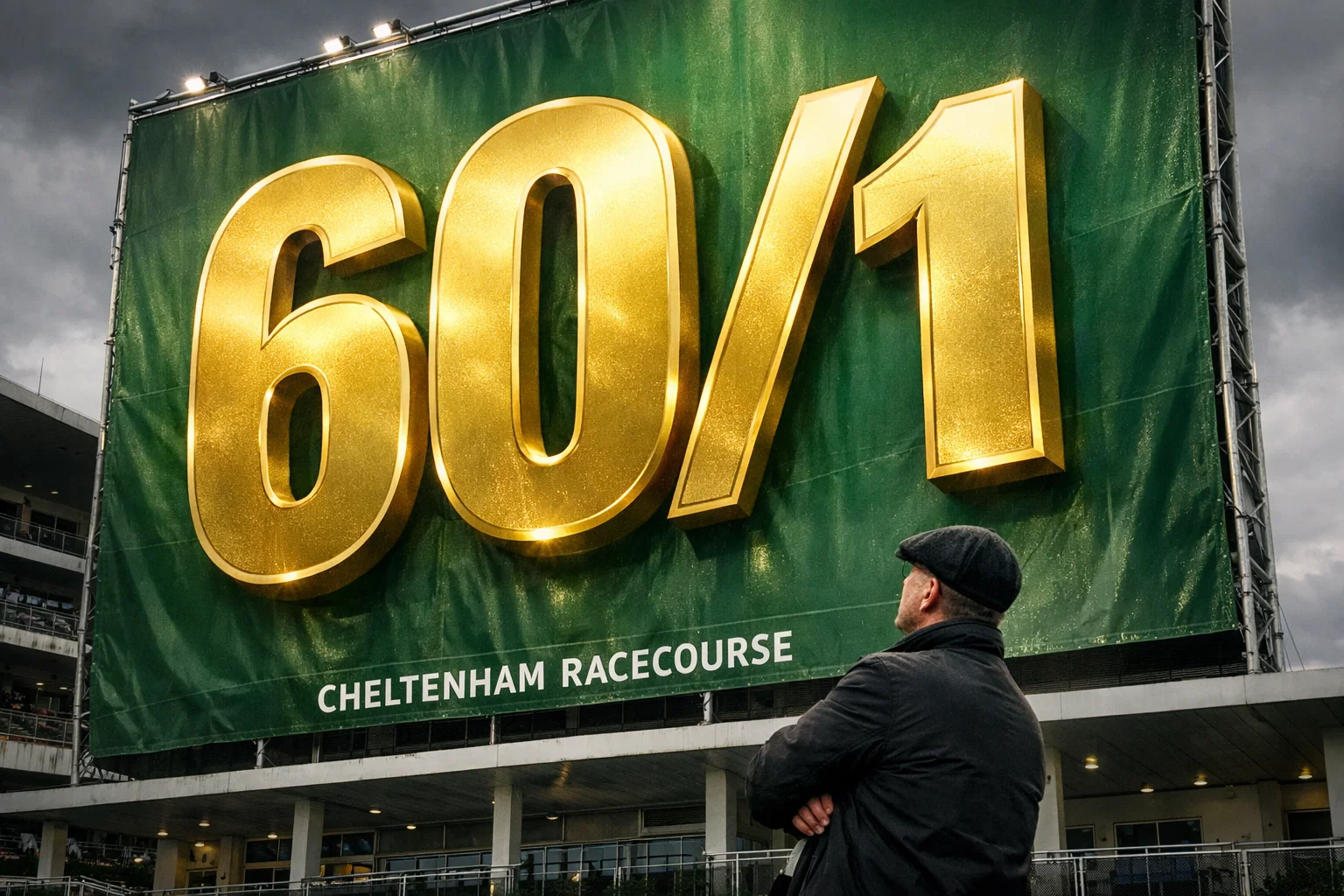
In this guide
What Super Boosts Are Really About
60/1 on the Champion Hurdle favourite. 80/1 on the Gold Cup market leader. The numbers are extraordinary, and that is precisely the point. Super boosts — also marketed as mega boosts, mega odds, or super-enhanced prices — are the most visually striking promotions bookmakers deploy during Cheltenham Festival week. They dominate social media timelines, app homepages, and push notifications. They are designed to stop you scrolling and start you depositing.
But super boosts and standard enhanced odds are not the same thing. While a regular price boost might take a 5/1 shot to 7/1 with a £25 max stake, a super boost takes a 2/1 favourite to 60/1 with a £1 max stake. The economics are entirely different. The headline number is astronomical, the potential profit is capped at a modest figure, and the primary purpose is customer acquisition rather than value delivery. With William Hill projecting £450 million in total Festival wagering, the cost of subsidising a few thousand £1 mega boosts is negligible against the turnover these promotions generate.
That does not make every super boost worthless. A £1 bet that returns £61 is still £60 in profit, and in certain scenarios, the expected value of even a capped super boost is positive. The question is whether the super boost is genuinely giving you something the standard market does not, or whether the headline odds are masking restrictions that reduce the offer to little more than an expensive advert. Headline odds, hidden caps — this guide breaks down which is which.
See also: cheltenham betting offers — your complete guide to Cheltenham betting offers.
How Super Boosts Work: The Economics
The business model behind super boosts is customer acquisition cost (CAC) arithmetic. Bookmakers spend significant sums to acquire new customers — television advertising, sponsorship deals, affiliate commissions, and digital marketing all carry substantial price tags. A super boost is an alternative acquisition channel: instead of paying an affiliate £100 to send a new customer, the bookmaker offers that customer 60/1 on a 2/1 shot with a £1 max stake. If the horse wins, the bookmaker pays out £60 (plus the £1 stake). If it loses, the bookmaker pays nothing. The expected cost to the bookmaker is the probability of winning multiplied by the payout — roughly £20 on a 2/1 shot — which is far cheaper than traditional advertising for comparable reach.
This explains why max stakes are always low. At £1, the bookmaker’s maximum liability per customer is the payout amount — £61 in the example above. Scale this across ten thousand customers, and the total exposure is approximately £200,000 in expected payouts (a third of customers win at 2/1 true odds, costing roughly £20 each). For an operator processing tens of millions of pounds in daily Festival turnover, this is a trivial line item in the marketing budget.
If the max stake were £10 instead of £1, the expected cost would multiply tenfold. At £50, it would become unworkable. This is why you will never see a super boost at 60/1 with a £50 max stake — the bookmaker’s liability would be enormous. The £1 cap is not an afterthought. It is the structural foundation of the entire promotion.
Some super boosts add a second layer of restriction: winnings paid partially or entirely as free bets rather than cash. If your 60/1 bet wins and the £60 profit arrives as a free bet with stake-not-returned rules, its real value drops to approximately £36–£45 (60–75% of face value, as established by OddsIndex analysis). The headline is 60/1 but your effective odds, after adjusting for the free bet payout, are closer to 36/1 to 45/1. Still significantly above the true 2/1, but not the number emblazoned across the promotion.
Marketing vs Value: Deconstructing a 60/1 Boost
Take a concrete example. A bookmaker offers 60/1 on the Champion Hurdle favourite, who is trading at 2/1 (3.0 decimal) in the standard market. The max stake is £1, and winnings are paid in cash.
The expected value calculation is straightforward. At true odds of 2/1, the horse has an implied win probability of approximately 33%. A £1 bet at 60/1 returns £61 if the horse wins. The expected value of the bet is: (0.33 × £61) – (0.67 × £1) = £20.13 – £0.67 = +£19.46. That is a positive expected value of almost £20 on a £1 bet. By any measure, this is an excellent bet.
But the profit is capped at £60 (£61 return minus £1 stake). You cannot place £10 and win £610. You cannot place £100 and win £6,100. The total economic impact on your Festival bankroll is limited to a maximum of £60, and the expected profit is roughly £19.46. Positive, yes. Transformative, no.
Now consider what you could have done with that same analytical confidence. If you believe the Champion Hurdle favourite has a 33% chance of winning and the standard market offers 2/1, the bet is fair value at any stake. A £50 bet at 2/1 yields £100 profit if the horse wins, with the same 33% probability. The expected value of that bet is (0.33 × £100) – (0.67 × £50) = £33 – £33.50 = –£0.50. Roughly break-even at the market price, as you would expect. But the potential profit of £100 dwarfs the super boost’s capped £60.
The super boost has better expected value per pound staked. The standard bet has better potential profit in absolute terms. Which matters more depends on your Festival strategy. If you are looking for small, positive-EV plays to accumulate across the week, the super boost is a rational addition — like picking up coins on the pavement. If you are looking for bets that can materially change your weekly profit and loss, the super boost is a distraction from the real opportunities.
One scenario where super boosts become genuinely interesting is when the horse loses. At 2/1 in the standard market, losing a £50 bet costs you £50. Losing the super boost costs you £1. If you want exposure to the Champion Hurdle favourite but are uncertain about the result, the super boost gives you a lottery-ticket upside for a nominal cost. The downside is irrelevant (£1), and the upside (£60) is pleasant if it lands. In this framing, the super boost is not a serious betting vehicle but a cheap speculative option — and there is nothing wrong with that, as long as you recognise it for what it is.
Evaluating Super Boosts: When to Take and When to Skip
A quick framework separates the worthwhile super boosts from the purely decorative ones. Three factors determine whether a specific mega boost deserves your £1.
Factor one: the underlying probability. Super boosts on short-priced selections (odds-on to 3/1 in the standard market) are almost always positive EV. The horse has a genuine chance of winning, and the boosted price dramatically overpays for that chance. Super boosts on outsiders — say, a 20/1 shot boosted to 200/1 — are less compelling because the underlying probability is low. The expected value might still be marginally positive, but the overwhelming likelihood is that you lose your £1. The sweet spot for super boost value is on selections priced between evens and 4/1 in the standard market.
Factor two: payout format. Cash payouts are always preferable to free bet payouts. A 60/1 super boost that pays £60 in cash is worth approximately 40–50% more than one that pays £60 in free bets. This single variable changes the effective odds from 60/1 (cash) to roughly 36/1–45/1 (free bet). Check the terms before placing the bet — the payout format is usually specified in the small print beneath the headline price.
Factor three: opportunity cost. During Cheltenham Festival, your time and attention are limited resources. Each day offers seven races, and every race has its own offers, boosts, and promotions to evaluate. Spending ten minutes researching a super boost that will net you, at best, £60 in one specific scenario might cost you the time needed to find a standard offer worth more in expected terms. If the super boost is on a horse you were already planning to back, take it as a free add-on. If it requires you to divert attention from your planned strategy, the opportunity cost may outweigh the expected gain.
Across the four days of Cheltenham 2026, expect to see between 8 and 15 super boost offers from major bookmakers. Of those, perhaps 3 or 4 will be on short-enough-priced selections with cash payouts to justify the attention. Take those, enjoy the enhanced upside, and do not mistake any of them for a serious component of your Festival betting strategy. They are bonuses, not foundations.
Explore enhanced odds at Cheltenham.
Controlling the Impulse Behind Big Numbers
Super boosts are designed to be exciting. The large numbers trigger an emotional response that can lead to impulsive behaviour — opening new accounts, depositing more than planned, or chasing mega boost opportunities across multiple bookmakers. Treat each super boost as a standalone £1 decision and do not let it pull you into additional spending.
If you feel that promotional offers are influencing you to gamble more than you want, step back. BeGambleAware.org provides free support, and the National Gambling Helpline is available on 0808 8020 133.
